Downtown After Dark: How Fireworks Are Rewriting Macon's Summer Skyline
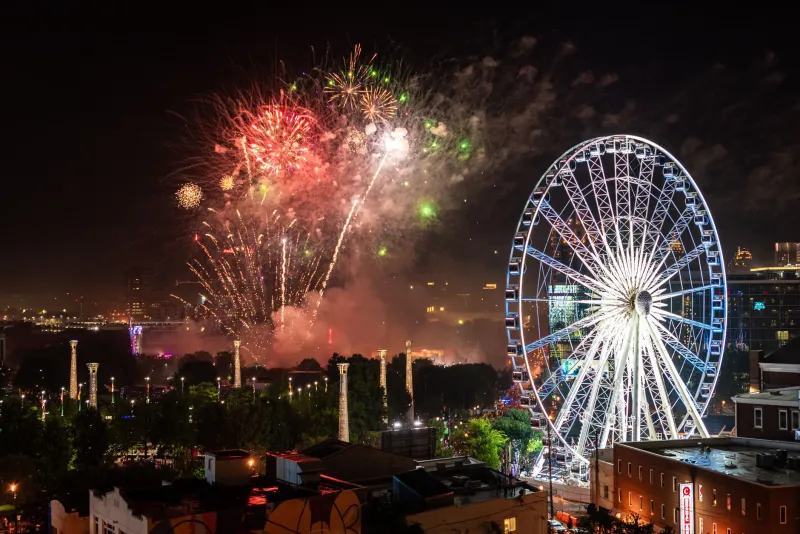
There's a moment — right around dusk on a big celebration night — when Macon does something quietly spectacular. The streetlights flicker on, the crowd along the riverfront starts to thicken, and the city's familiar rooftops and steeples take on a completely different character. Then the first shell breaks overhead, and for a few brilliant seconds, downtown Macon looks like nowhere else on earth.
That image hasn't stayed the same over the years. Ask anyone who's been watching from a lawn chair on the same stretch of Cherry Street for the past two decades, and they'll tell you: the sky looks different now. Better in some ways, more complicated in others, but undeniably different. And the reasons why stretch from cutting-edge pyrotechnics technology all the way down to the simple fact that Macon keeps building things.
The Tech Behind the Transformation
If you've noticed that recent fireworks shows feel more precise — colors sharper, timing tighter, effects more layered — you're not imagining it. The industry has changed significantly over the past ten to fifteen years, and Middle Georgia's biggest displays have kept pace.
Digital firing systems have replaced many of the older manual setups, allowing pyrotechnicians to choreograph shells with split-second accuracy. Computer-controlled ignition means a show designer can program a cascade of effects that would have required twice the crew and twice the setup time a generation ago. The result is a display that feels less like a series of individual explosions and more like a coherent visual composition — one that interacts with the skyline rather than just hovering above it.
Low-level effects have become a bigger part of the toolkit too. Mines, comets, and ground-based pieces that once felt like filler are now integrated into the design of a show in ways that make the entire vertical space — from street level to a few hundred feet up — feel alive. For a downtown environment like Macon's, where buildings, bridges, and historic architecture all share the frame, that shift matters a lot.
Where the Shells Actually Come From
Launch site selection is one of the less glamorous but more consequential decisions behind any downtown fireworks show. In Macon, the options have evolved as the city has developed, and not always in straightforward ways.
The Ocmulgee River corridor has long served as a natural staging ground — the water provides a safety buffer, and the open sightlines from the opposite bank give spectators a clean view. But as development along the riverfront has intensified in recent years, the calculus has gotten more complex. New construction can block existing sightlines, create new fire risk considerations, or simply change where a crowd naturally gathers and therefore where a launch site makes sense.
Event planners working on Macon's larger shows say they're in constant conversation with city officials about these logistics. It's not just about finding a flat patch of ground with enough clearance — it's about understanding how a given location will shape what the show looks like from multiple vantage points across the city simultaneously.
"You're not just thinking about the people standing right in front of you," one local event coordinator explained. "You're thinking about the person watching from a rooftop bar three blocks away, the family set up in Tattnall Square Park, the folks in East Macon who can see the top half of the show over the tree line. Every launch site decision changes the experience for all of them."
The Neighborhoods That Won the View Lottery
Speak to longtime Macon residents about their favorite spots to watch a show, and you'll hear a fascinating oral history of the city's geography. Some of the best vantage points are obvious — elevated ground near the historic district, open lots near the river, rooftop venues that have popped up as downtown's dining and entertainment scene has matured.
But a few neighborhoods have quietly become prime viewing territory in ways that weren't entirely planned. Parts of the Beall's Hill neighborhood, for instance, offer elevated perspectives that frame a downtown show beautifully against the city grid below. Certain stretches near Wesleyan Drive catch the reflection of aerial bursts off the Ocmulgee on the right nights. These spots get passed around among locals like a secret recipe — not quite hidden, but not exactly on the official visitor's map either.
The flip side is that some traditionally good viewing areas have lost ground to development. A vacant lot that once gave a clean southern view of a launch site might now have a three-story mixed-use building on it. Progress and perspective don't always point in the same direction.
What City Officials Are Watching
Macon-Bibb County has been paying closer attention to how fireworks intersect with downtown development planning, even if that conversation doesn't always happen under that specific label. Permitting processes, safety setbacks, and coordination with fire and emergency services all factor into where and how major shows get staged.
City officials who've been involved in planning large civic celebrations point to the increased sophistication of the shows themselves as both an opportunity and a responsibility. More elaborate displays require more lead time, more coordination, and more precise site assessment. As Macon's downtown footprint fills in, finding sites that check every box gets harder.
There's also the question of community impact. Fireworks that light up one neighborhood beautifully might create noise or traffic headaches for another. Getting that balance right is an ongoing process, and it's one that involves more stakeholders than most people realize.
The View From the Porch
For all the technology and logistics involved, the most compelling part of this story might be the simplest one: the people who've watched Macon's celebration sky change from their own front porches.
Residents who've lived in the same homes near downtown for thirty or forty years describe the evolution in almost painterly terms. The colors are richer now, they say. The shows feel longer and more intentional. There's a sense that someone is actually composing what you're seeing, not just lighting fuses and hoping for the best.
But there's also a nostalgia for older, rougher shows — the ones where you could hear the individual crew members shouting over the noise, where the smoke hung low enough to drift into the crowd, where the whole thing felt a little dangerous and a lot alive. Those shows had a texture that precision sometimes smooths away.
What's Coming Next
The fireworks industry is already experimenting with drone light shows as either a complement to or replacement for traditional pyrotechnics in some markets. Macon isn't there yet, and the people who love a real aerial burst wouldn't have it any other way. But the technology is circling closer, and it's not hard to imagine a future where a hybrid show — drones handling the intricate, low-altitude choreography while traditional shells handle the big emotional payoffs — becomes the standard for major civic events.
What that would mean for downtown Macon's skyline is genuinely hard to predict. It might open up new staging possibilities, free from the safety setbacks that traditional pyrotechnics require. It might let shows get closer to buildings, more integrated with the architecture, more site-specific in ways that feel uniquely Macon.
For now, though, the city's summer skyline belongs to the shells and the smoke and the crowd noise and the moment when everyone tilts their head back at the same time. That's not changing anytime soon. And honestly? We wouldn't want it to.


